The Mathematical Mind: Discovering Math at the Early Childhood Level
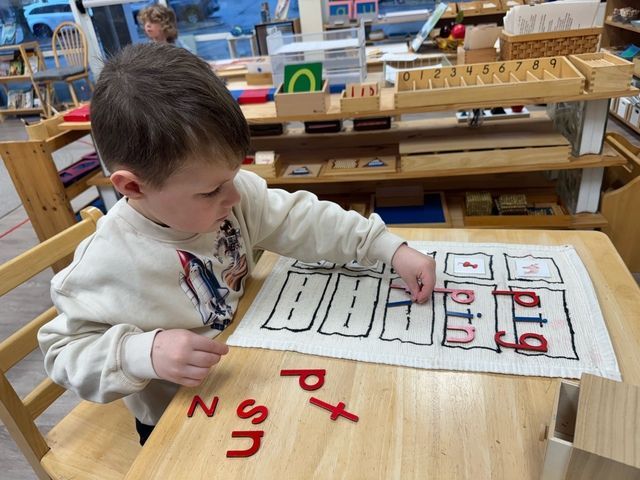
Whether we embrace math or not, humans have a natural tendency to seek patterns, quantify, and make logical connections. Dr. Maria Montessori observed that young children possess an innate mathematical mind—a natural inclination to bring order and precision to their world.
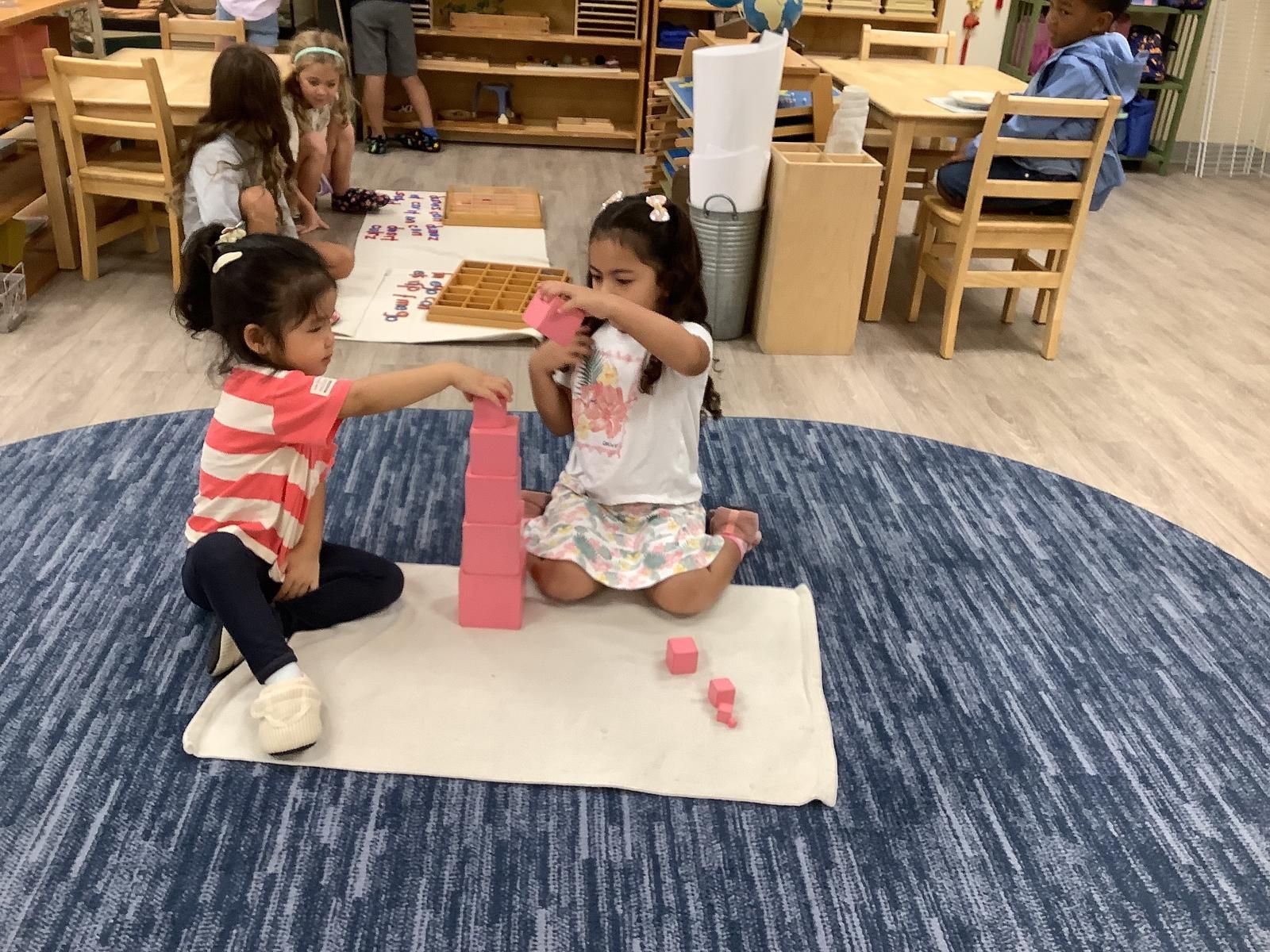
In Early Childhood classrooms (ages 3 to 6) at Montessori School of Louisville, we nurture this innate curiosity by offering hands-on learning experiences that lay a deep, conceptual foundation for mathematics long before abstract arithmetic is introduced on paper.
Organized into six progressive strands, our mathematical exercises guide children from a foundational understanding of quantities 1 to 10 to working with large place values in the decimal system, internalizing math facts, exploring early fractions, and embarking on the journey toward true abstraction.
1. Numbers 1 to 10: Isolating Concepts and Building Quantity
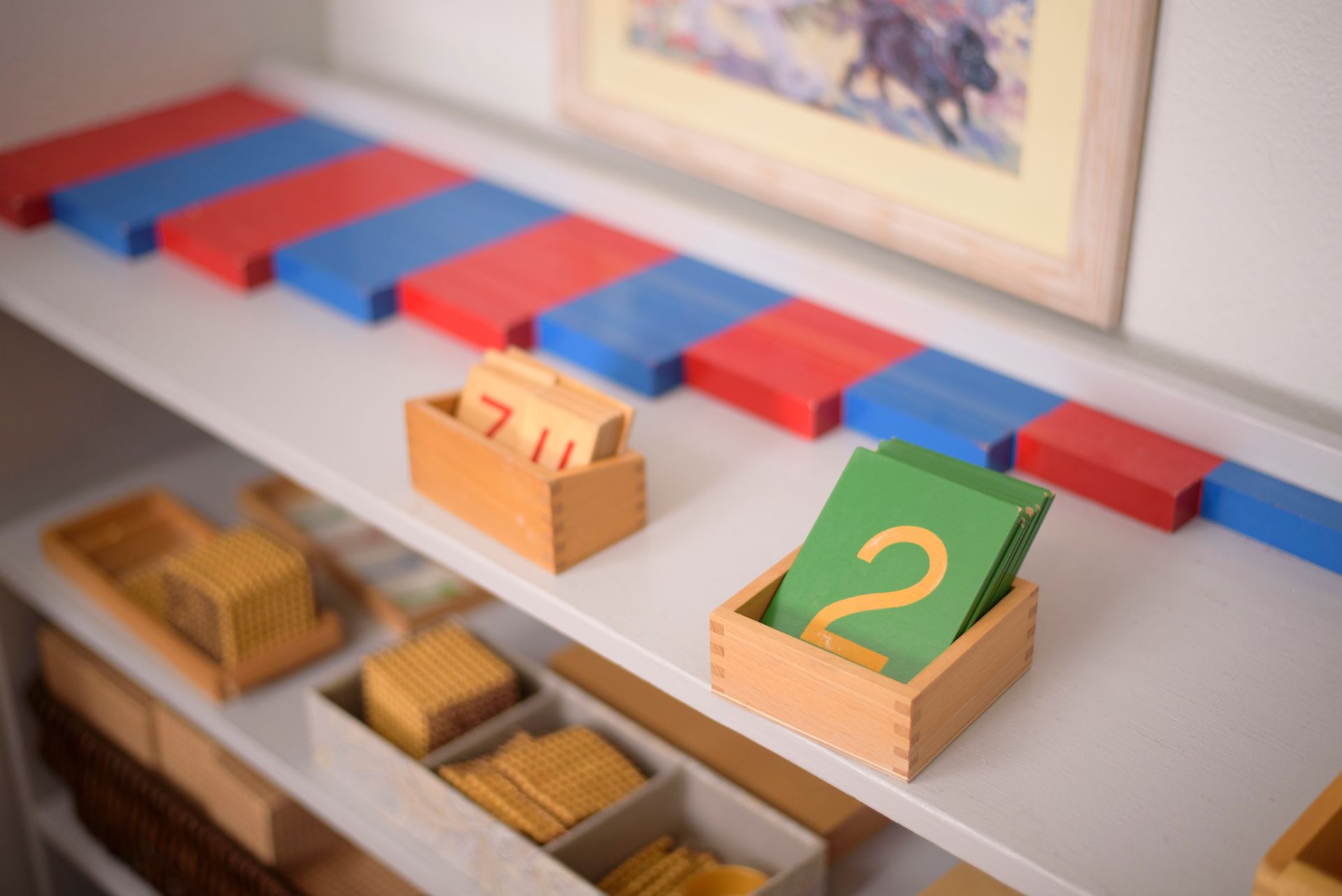
Although learning the numbers 1 through 10 sounds simple, it involves integrating several distinct mathematical concepts: name, symbol, quantity, and sequence. Montessori materials isolate each concept so a child’s understanding grows through clear, logical steps.
- The Number Rods: Alternating red and blue sections help the child perceive quantity as a single entity rather than scattered units, while practicing one-to-one correspondence.
- Sandpaper Numbers: Children trace numerals with their fingertips, linking the tactile muscle memory of the symbol with its spoken name.
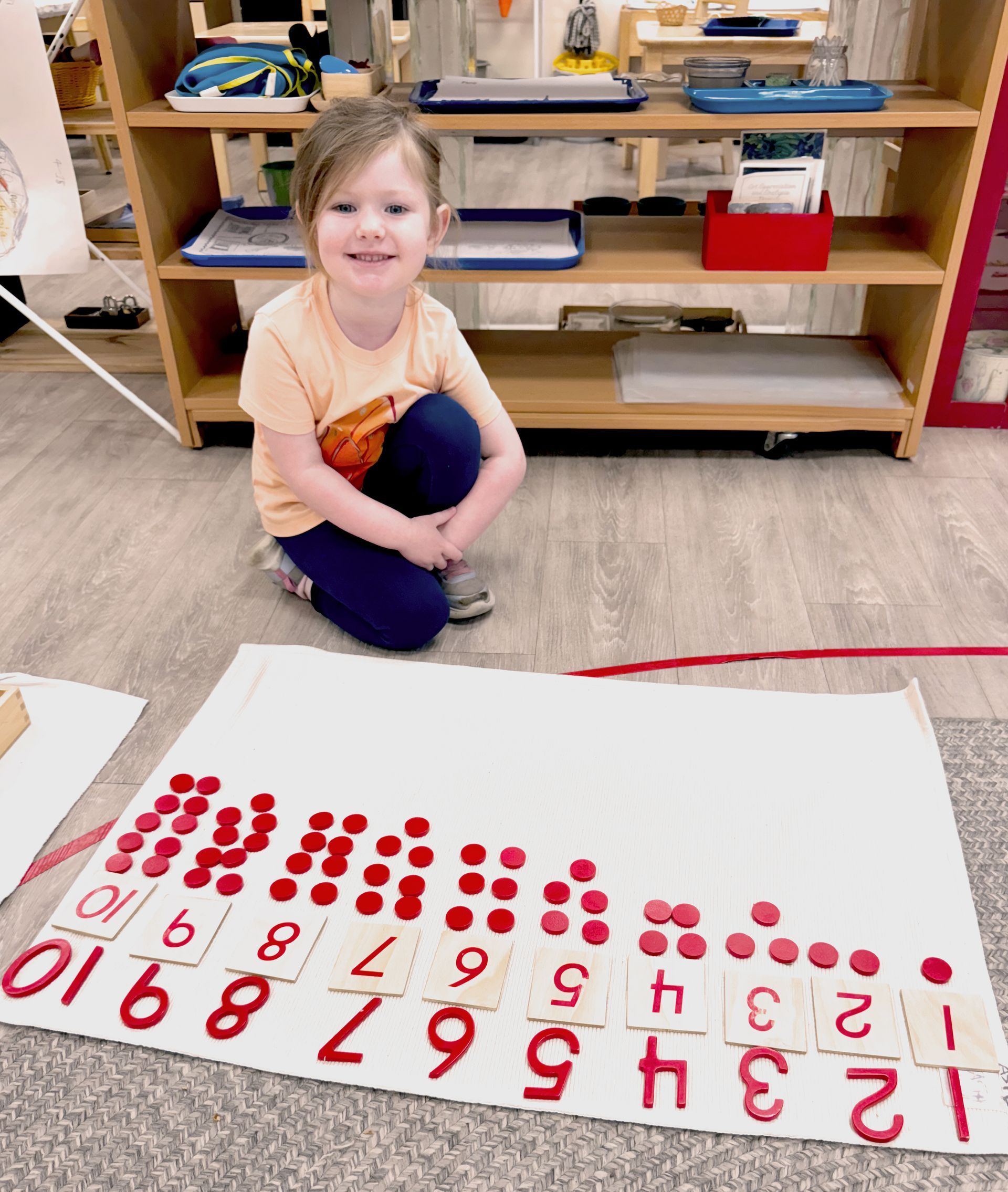
- Connecting Symbols to Quantities: Once numerals are recognized, children link number cards with the corresponding number rods.
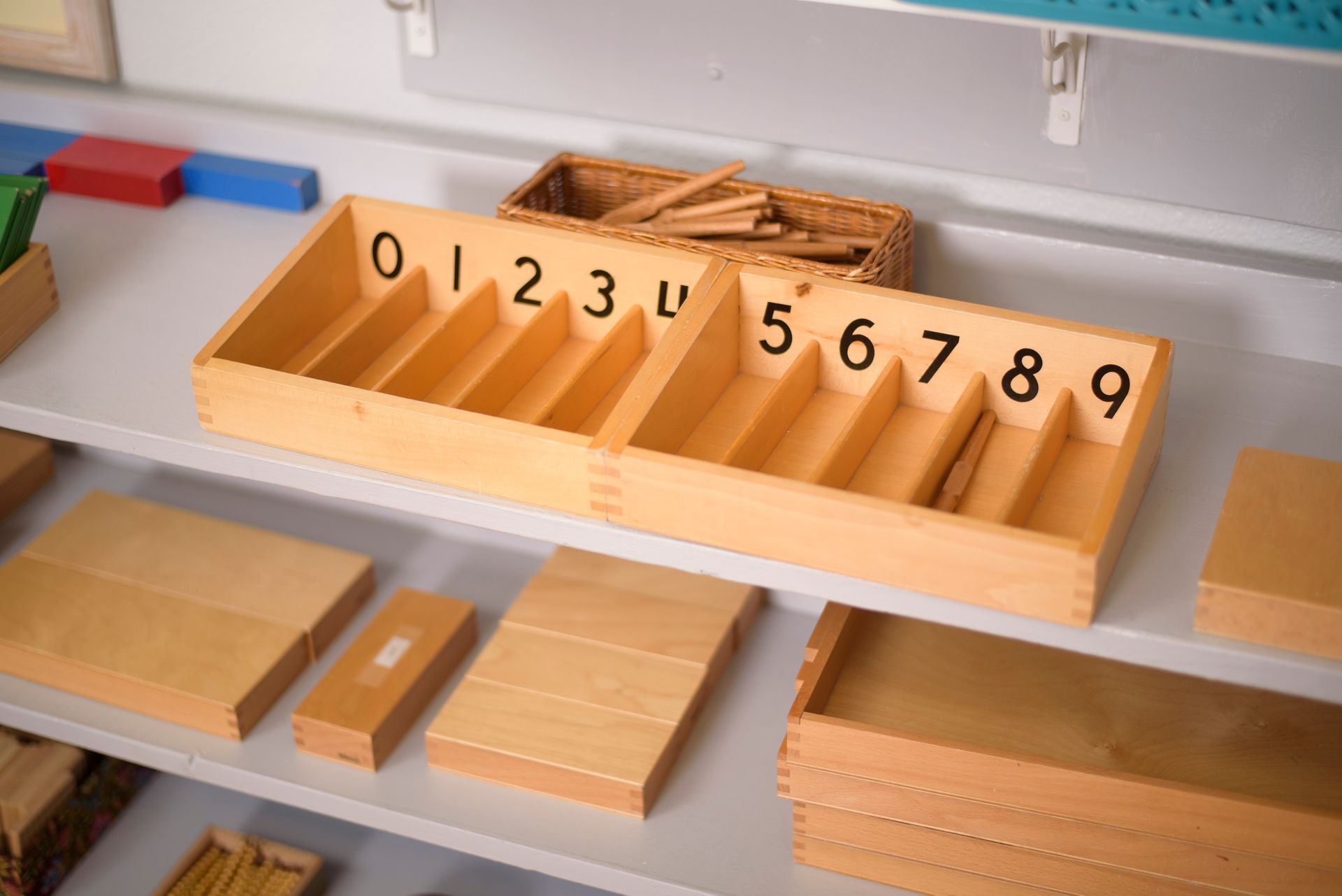
- Spindle Boxes & Cards and Counters: These materials transition the child from viewing quantity as a single physical object to grasping how individual units make up a set, while introducing the concept of zero.
- Early Operations: Long before writing formal equations, children engage in experiential games that give an intuitive impression of addition, subtraction, multiplication, and division.
2. The Decimal System: Hands-On Hierarchy and Place Value
Once a child has mastered 1 through 10, they are introduced to the golden bead material, which sensorially illustrates the decimal system. Because no place value ever holds more than nine, children naturally understand the transition across units, tens, hundreds, and thousands.
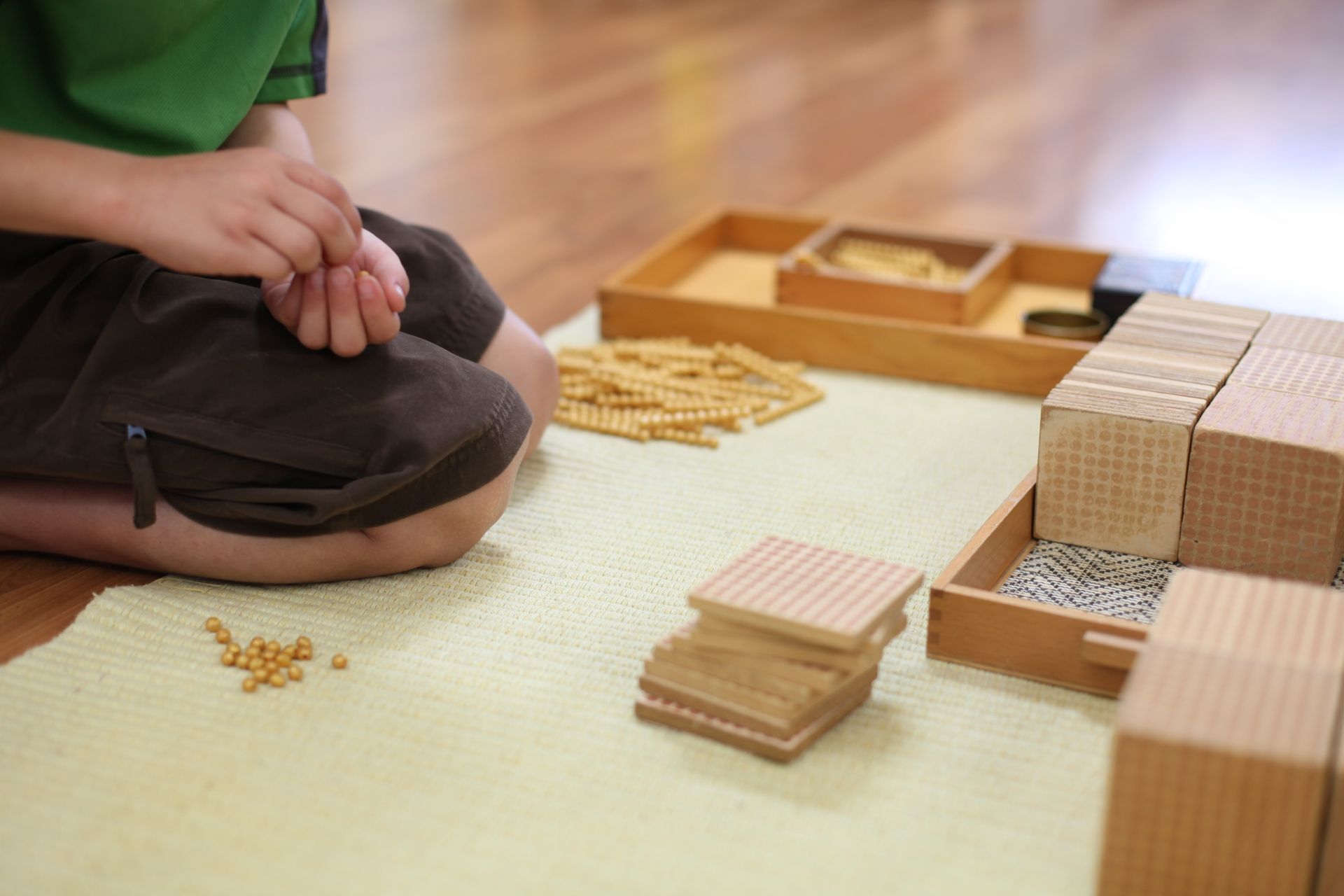
By physically holding a single unit bead alongside a heavy wooden cube of 1,000 golden beads, the child feels the tangible, geometric difference in place value.
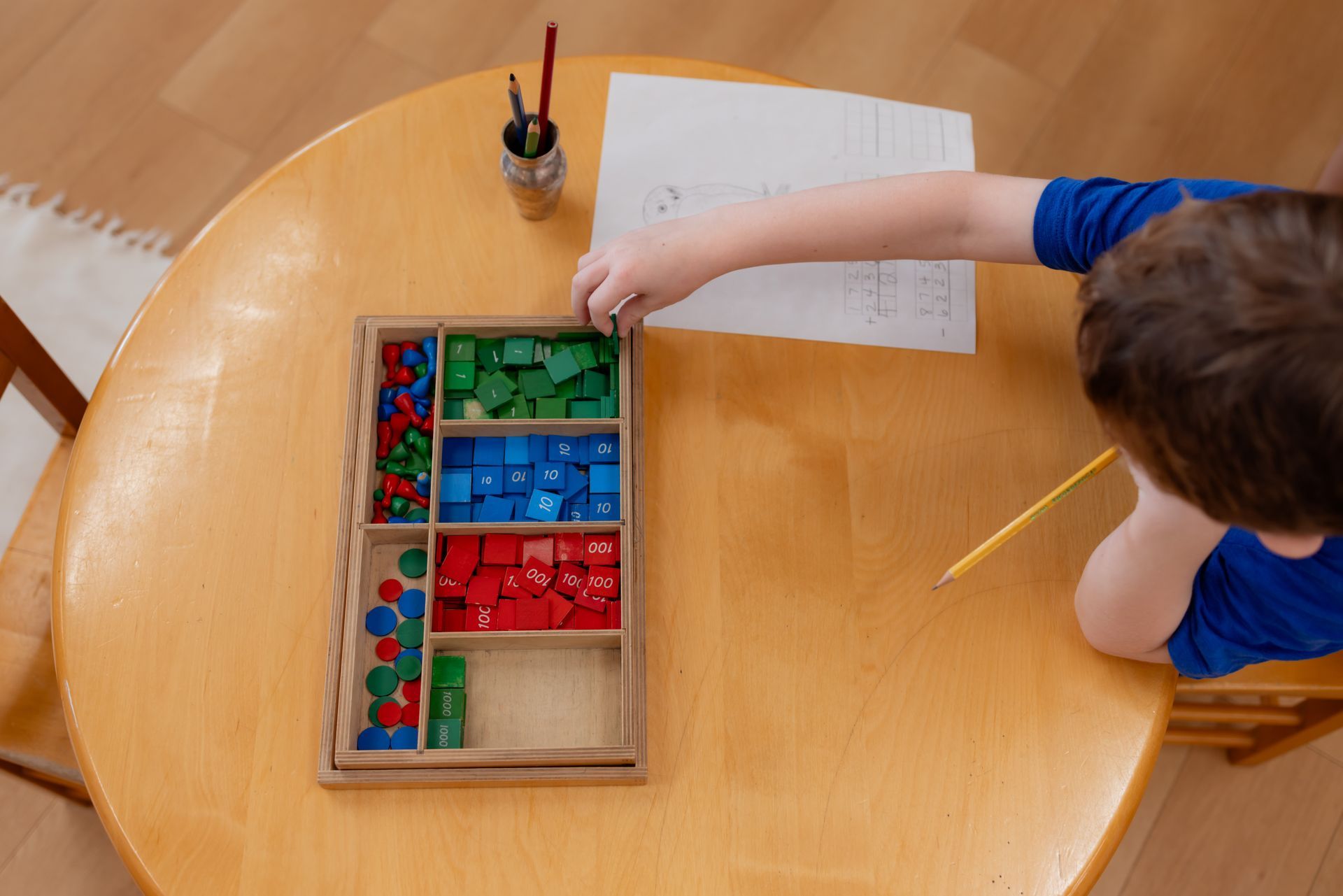
Through hands-on work with the golden beads, children perform dynamic arithmetic. The child composes large four-digit numbers, exchanging ten units for a ten bar, or ten hundreds for a thousand cube. We focus deeply on the process of the operation to understand what it means to join quantities together or separate them into groups, rather than rushing toward a written answer.
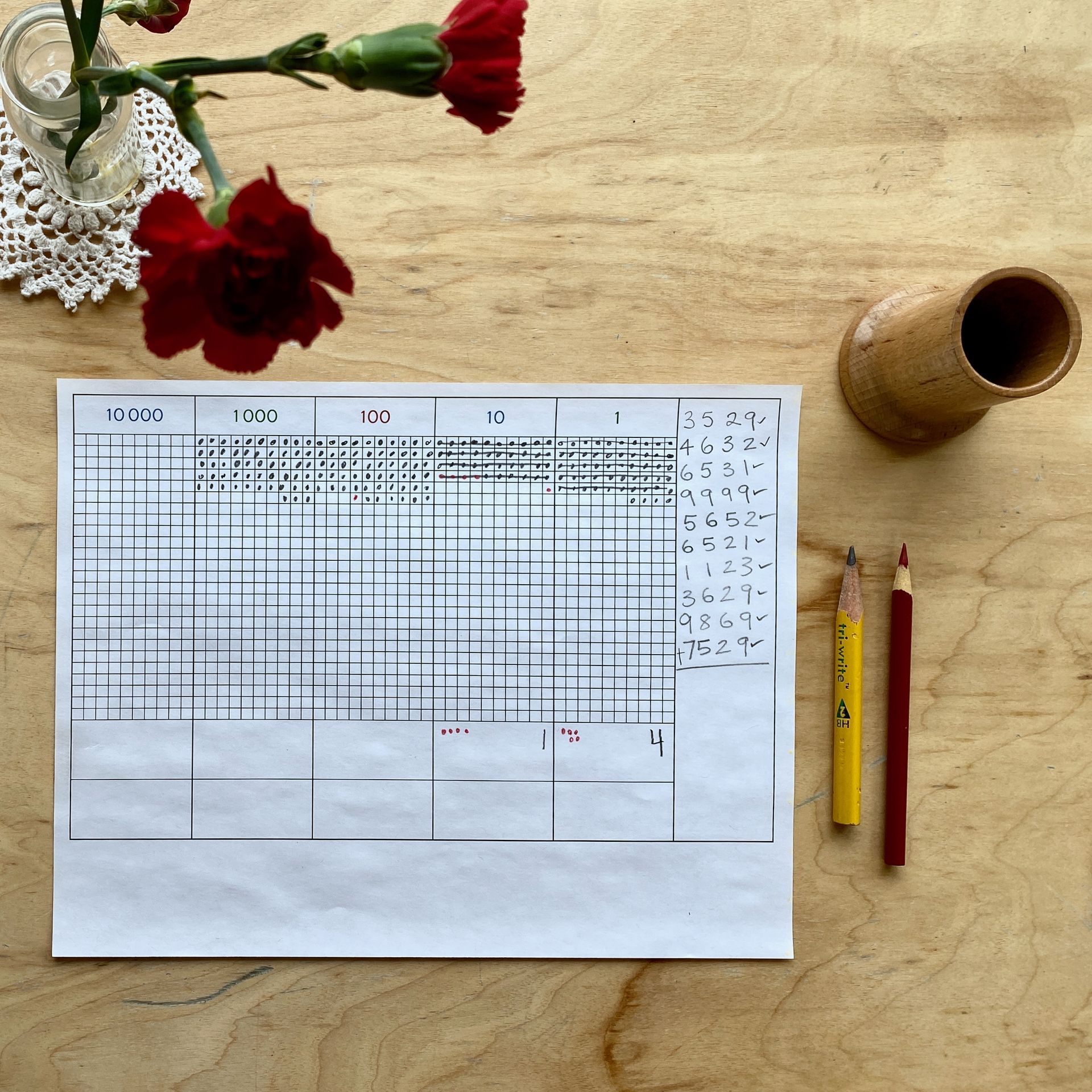
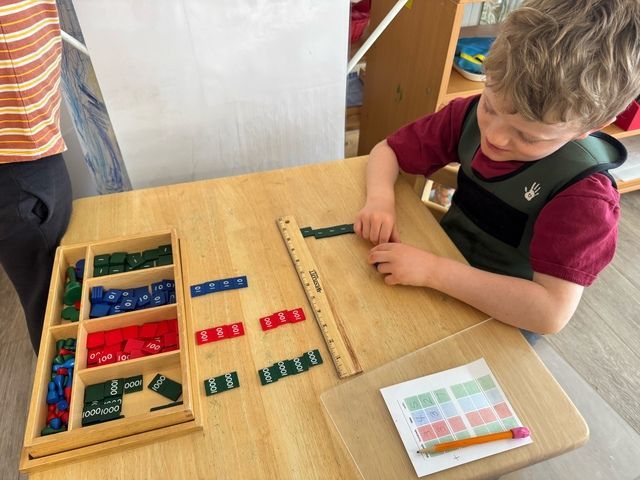
As understanding grows, materials like the Stamp Game and Dot Game gently guide the child away from concrete objects toward symbolic calculation.
3. Continuation of Counting: Teens, Tens, and Linear Progressions
In this strand, children extend their understanding to numbers 11 through 100 and consolidate linear counting up to 1,000.
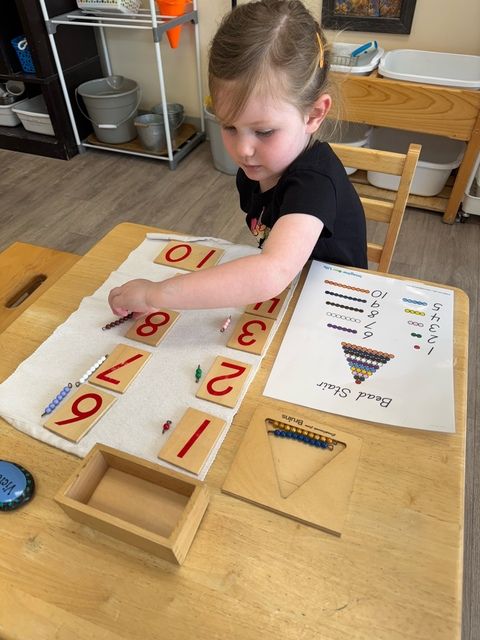
- Teen Boards & Tens Boards: Children combine numeric symbols with bead bars to see how 10 and 1 become 11, or how four tens become 40.
- The Colored Bead Stair: Provides a color-coded sensorial representation of numbers 1 through 10, a visual pattern utilized throughout advanced Montessori math.
- The Bead Chains: Children lay out long bead chains across the classroom rug, seeing the dramatic physical difference between 100 (102) and 1,000 (103). Unrolling these chains allows children to practice skip counting, building the natural foundation for multiplication.
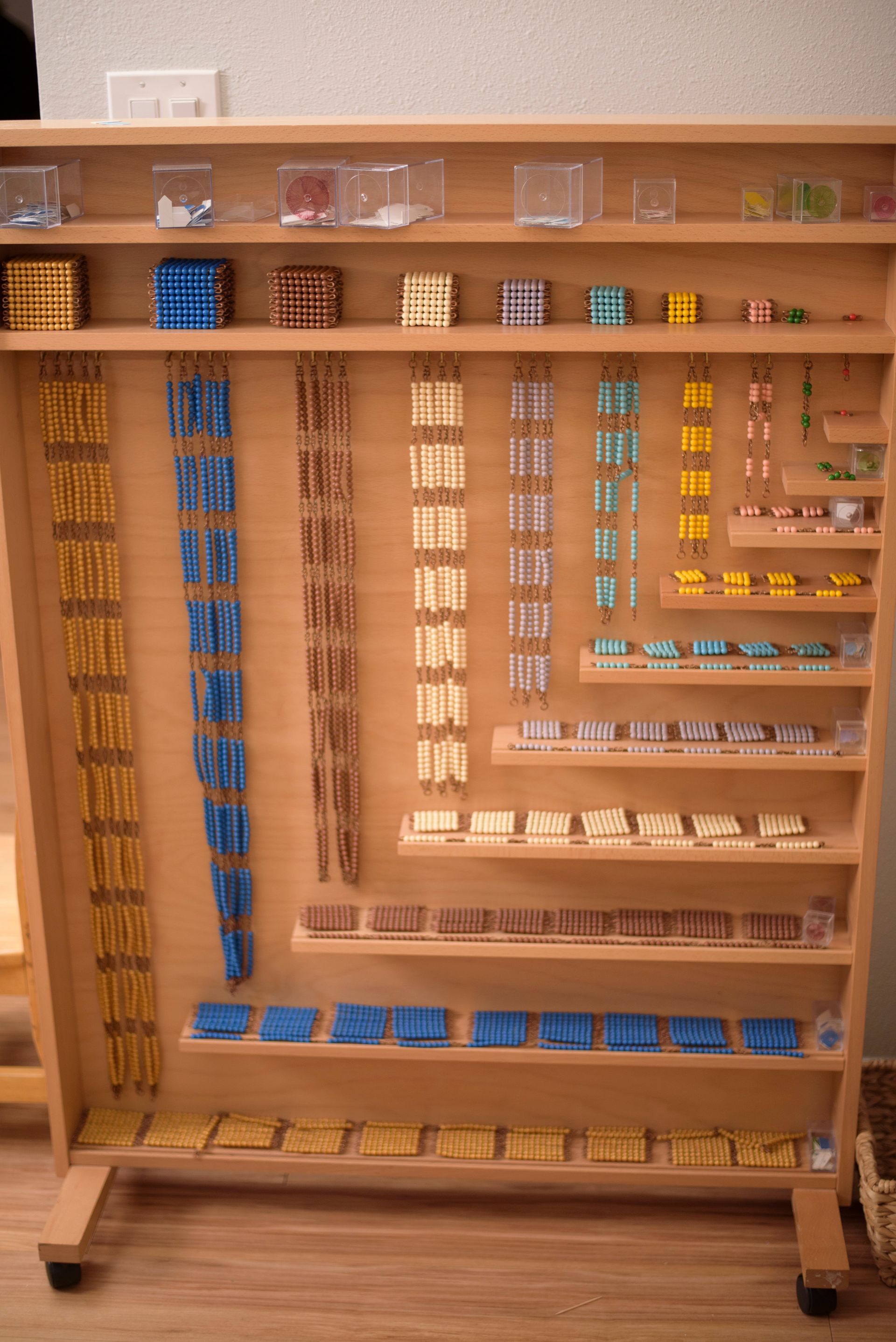
Mental maturity enables children to move beyond rote counting to deeply comprehending the physical quantities represented by numbers.
4. Exploration and Memorization of Essential Math Facts
Montessori materials transform fact memorization into a tactile, visual discovery. Through repetitive practice with the Addition and Subtraction Strip Boards, the Addition Snake Game, the Multiplication Bead Board, and the Unit Division Board, children explore math facts sensorially.
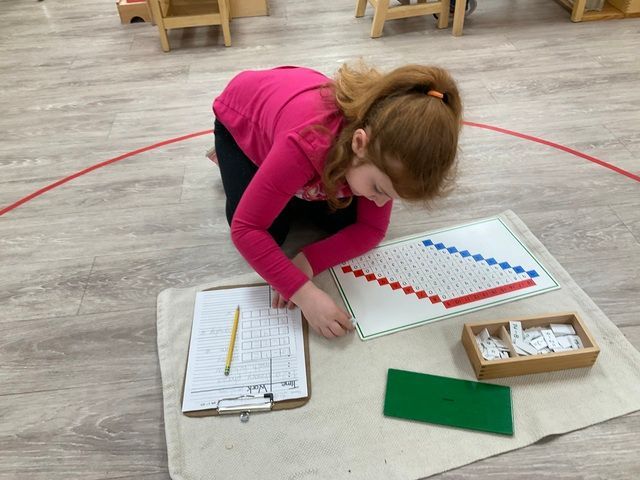
A child learns what 56 looks like by laying out five 6-bead bars. Over time, this visual and tactile repetition builds strong neural pathways. As children move toward abstract representations and test themselves with blank chart exercises, they discover that mental calculation is faster than retrieving materials. What an igniting and enthusiastic way to transition to mental math.
5. The Passage to Abstraction
As children approach the end of their Primary years (around age 6), they seek efficiency and logical reasoning. The materials for the passage to abstraction bridge concrete understanding and logical execution.
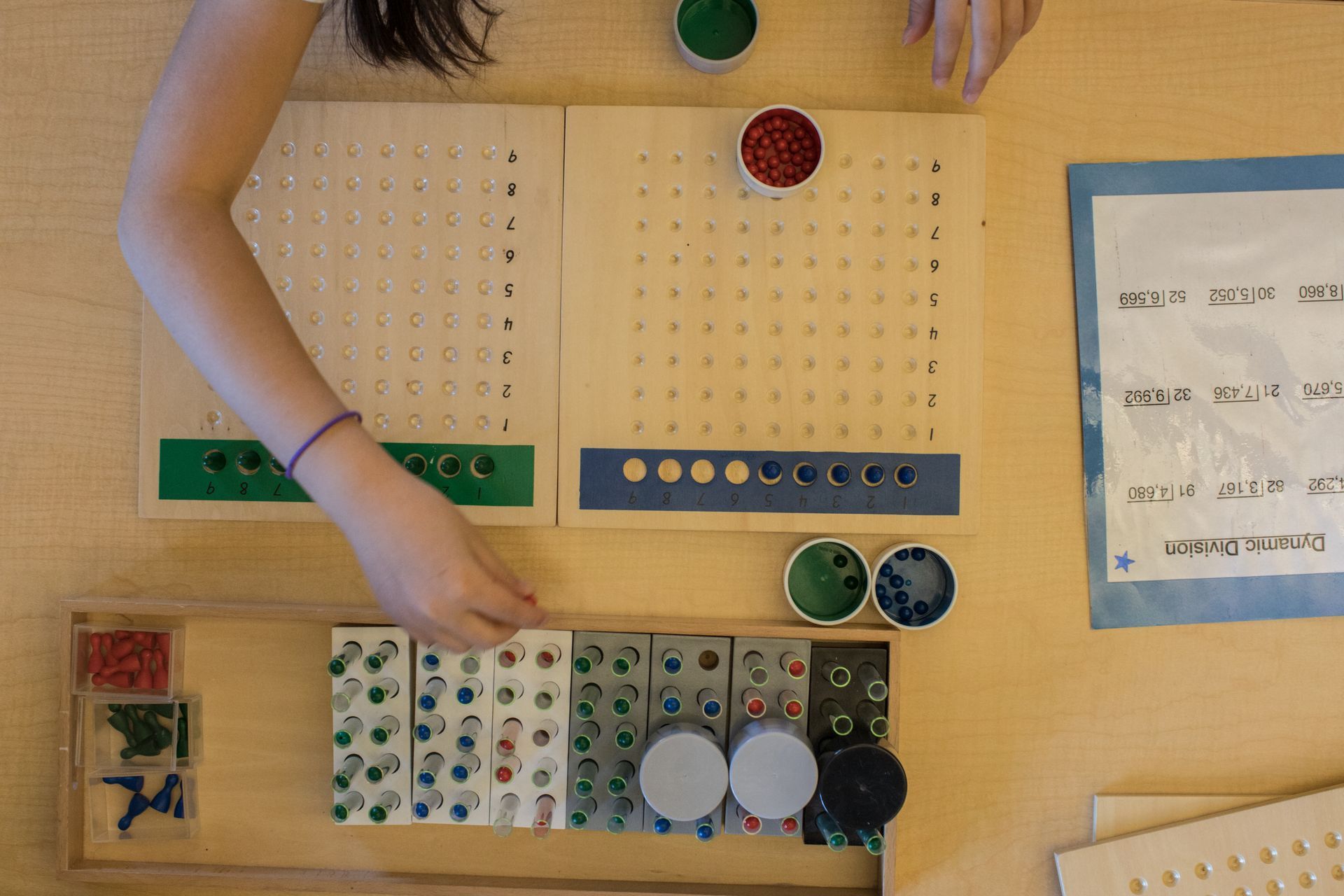
- Small Bead Frame: Revisits addition and subtraction with abacus-style beads, deepening place value alignment.
- Wooden Hierarchy Material: Offers a breathtaking visual and symbolic introduction to quantities up to one million.
- Large Bead Frame & Racks and Tubes: Prepares children for multi-digit multiplication and long division with larger divisors and dividends.
Through these hands-on steps, children step into Elementary learning with complete logical confidence in mathematical processes.
6. Early Fractions: Sensorial Exploration to Equivalence
Fractions are introduced sensorially early in the Early Childhood level using green wooden fraction apples and cut-out metal fraction inset circles. Young children hold half, a third, or a tenth in their hands long before writing a fraction symbol.
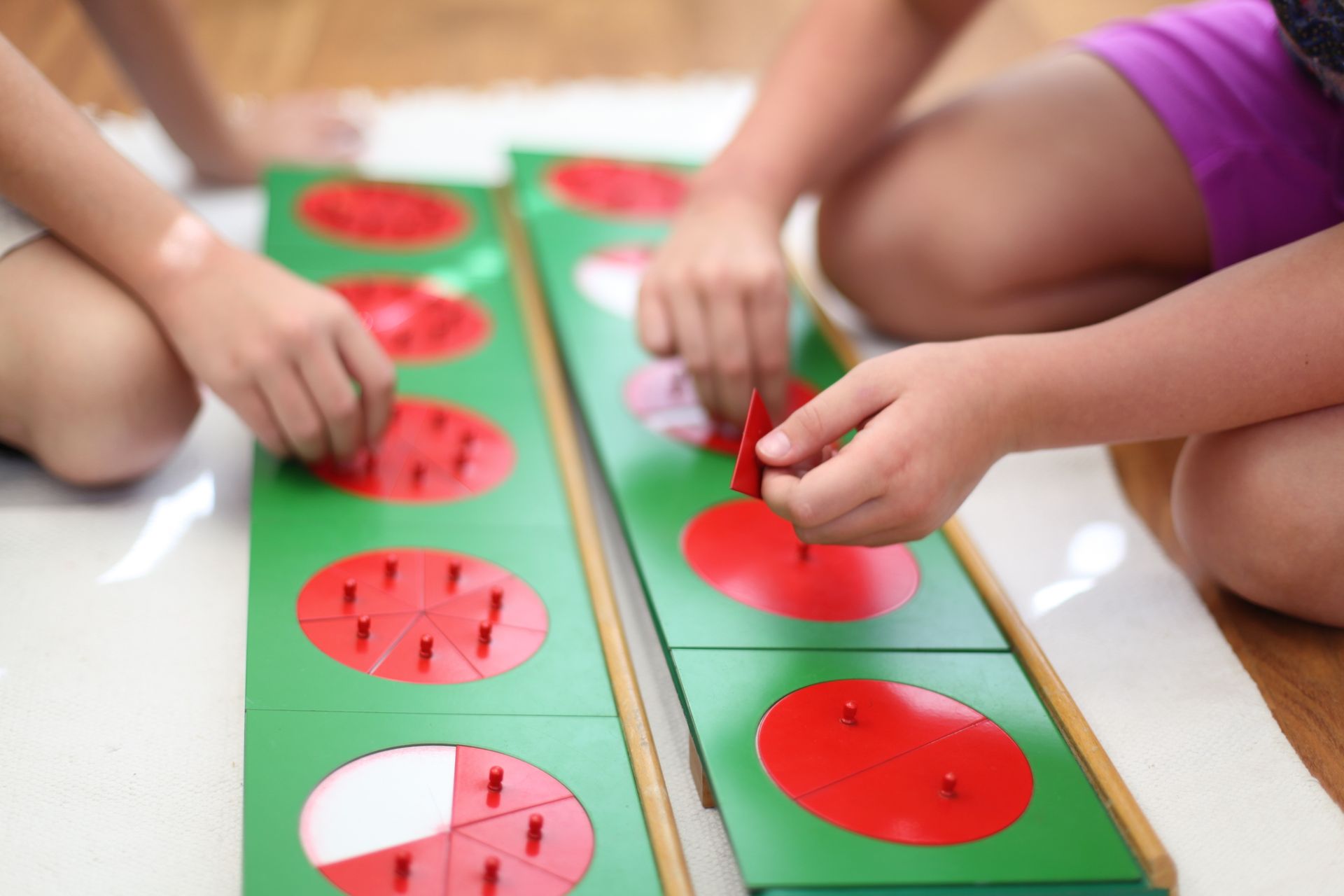
As their mathematical mind matures, children return to these materials to explore quantities smaller than one whole, practice simple operations, and discover equivalent fractions through tactile exploration.
Building Mathematical Confidence for Life
At Montessori School of Louisville, our math curriculum respects each child's developmental timeline. By offering concrete experiences first, linking them to symbolic representations, and allowing ample time for repetition and self-correction, we cultivate children who do not simply memorize math; they understand it, enjoy it, and thrive in it.
We invite you to observe our vibrant Early Childhood classrooms and see children's mathematical minds in action. Schedule a tour to experience the MSL difference!