Babies to Toddlers: Communication for Connection
Our ability to communicate through language is a key part of what makes us human. Indeed, it is language that binds together communities and provides the communicative power for people to work together.
As these human connections and civilizations developed, language has played a significant role in how the human mind has developed. This powerful force begins to arise before birth and significantly impacts our developing children.
Prenatal through Birth
In utero, the baby’s auditory system begins working quite early. A 13- to 14-week-old fetus is already listening to sounds. Thus, talking to a baby while in utero is extremely important not only for providing the baby with familiar points of reference after birth but also for providing the unborn baby with the opportunity to develop their auditory skills.
After birth, the newborn is able to recognize the mother’s voice and shows an awareness of human voices over other sounds in the environment. Babies’ brains are designed to not only perceive speech sounds but also to discriminate and categorize many diverse phonemes (individual sounds of speech).
Two to Three Months
During the first two or three months, the baby’s cries are a form of early communication, and biological changes in the baby allow them to begin modulating their sounds. With some physical changes maturing by around three to four months of age, babies engage in lots of experimentation. They will begin cooing and gurgling, which then eventually develops into babbling. They can clearly produce vowels and do so in an almost joyful way!
Thus, as adults in the baby’s life, we should respond to these vocalizations with interest, to begin a back-and-forth dialogue that provides the baby with feedback and engages their interest in communicating more.
Five to Seven Months
Next, the baby will begin to produce consonants and later put together a string of syllables. Between five and seven months, babies begin to play around with sounds. Now they aren’t just expressing their physical and emotional state of being, and instead are experimenting with sequences of all sorts of sounds, including consonants. Between seven and eight months syllables emerge in their babbling and by the end of the first year they will create more variation that starts to mimic sentence format.
As the child discovers their ability to produce sounds, they experiment with various possibilities and joyfully exercise these abilities. They will also begin to notice how certain sounds (like mama) can cause delighted responses in adults.
This give-and-take in communication elucidates another aspect of language development. Not only is the child learning how to produce language through sounds, they are also learning that sounds, especially when put together in certain ways, have meaning. Babies begin to find patterns in the stream of spoken language. By the time babies are nine months old, they are able to do more than just notice sounds; they are able to hear sequences of sounds.
Nine to Twelve Months
From nine to twelve months, babies enter an exciting period of identifying more words in the language stream, wanting to communicate and share, remembering units of sound that form words, and beginning the early stages of actually pronouncing words. As a child enters this time of intentional communication, it is worth noting that their understanding of language is more progressed than their ability to produce language.
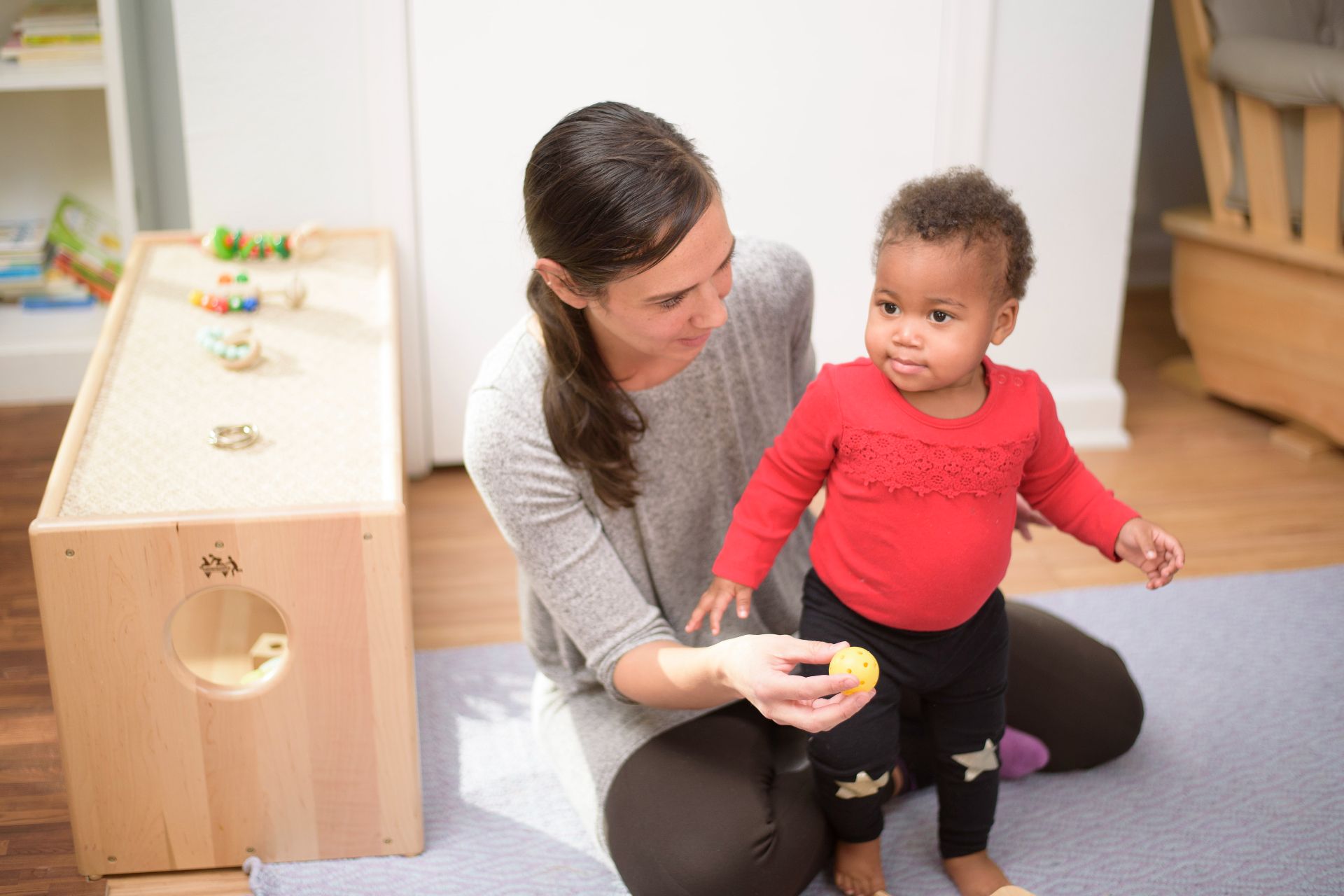
In this phase, a child will often use one word over and over, perhaps to communicate different things. This is a critical time. When we respond to a baby or toddler’s intention to communicate, we give a message that legitimizes these attempts to communicate, thereby empowering the child to keep trying. How we respond to an emerging communicator in fact determines how successfully the one-year-old will be able to communicate.
“Babies at nine months whose mothers followed the baby’s lead, who responded to what the baby was interested in, had larger comprehension vocabularies at thirteen months.”— How Babies Talk: The Magic and Mystery of Language in the First Three Years of Life
12 Months and Beyond
The period from 12 to 20 months (about 1 and a half years) is marked by remarkable growth in vocabulary. Although new words seem to accumulate slowly and with effort in the first part of this phase, a point is reached at the end of this period of growth in which new words emerge daily and effortlessly. This is when children have an explosion in their awareness of and use of nouns, and is a valuable time for the young toddler to be introduced to a meaningful and rich vocabulary.
After a toddler learns about 50 words, there is a tipping point, and their vocabulary development takes flight. After about 20 months (about 1 and a half years), the child experiences an increase of hundreds of new nouns, prepositions, verbs, and adjectives, as well as the use of grammar and parts of speech. The almost two-year-old is learning new words at an astonishing pace: approximately nine new words a day, which is 63 new words per week.
Their use of phrases lengthens and becomes more complex as the child in this phase quickly acquires all the basic rules of syntax. The other remarkable aspect of this language development is that the child is able to understand that a leaf is a general term for a variety of types of leaves, whether maple leaves, willow leaves, oak leaves, etc. As toddlers add words to their vocabularies, they are actively sorting and categorizing the words.
This is when our little ones begin to describe not only their surroundings, but also their own emotions and responses to different stimuli. From eighteen to twenty-four months, the toddler uses simple sentences for self-expression. The turning point is when the child is able to refer to themself in the first person, rather than the third person.
With this increased sophistication, the older toddler begins to use language in a more practical and social way. Language is used to accomplish goals and the child becomes more aware of the pragmatic use of language.
This pattern of language development is predictable, although with some typical ranges in terms of the child’s exact age of mastery of each stage. With only a few slight differences based on particular languages, the general pattern of developing language fluency is the same.
Humans are hard-wired to communicate, and thus connect and collaborate. The interactions and support we provide to the child from before birth and through these sensitive first three years are instrumental.