Movement Matters!
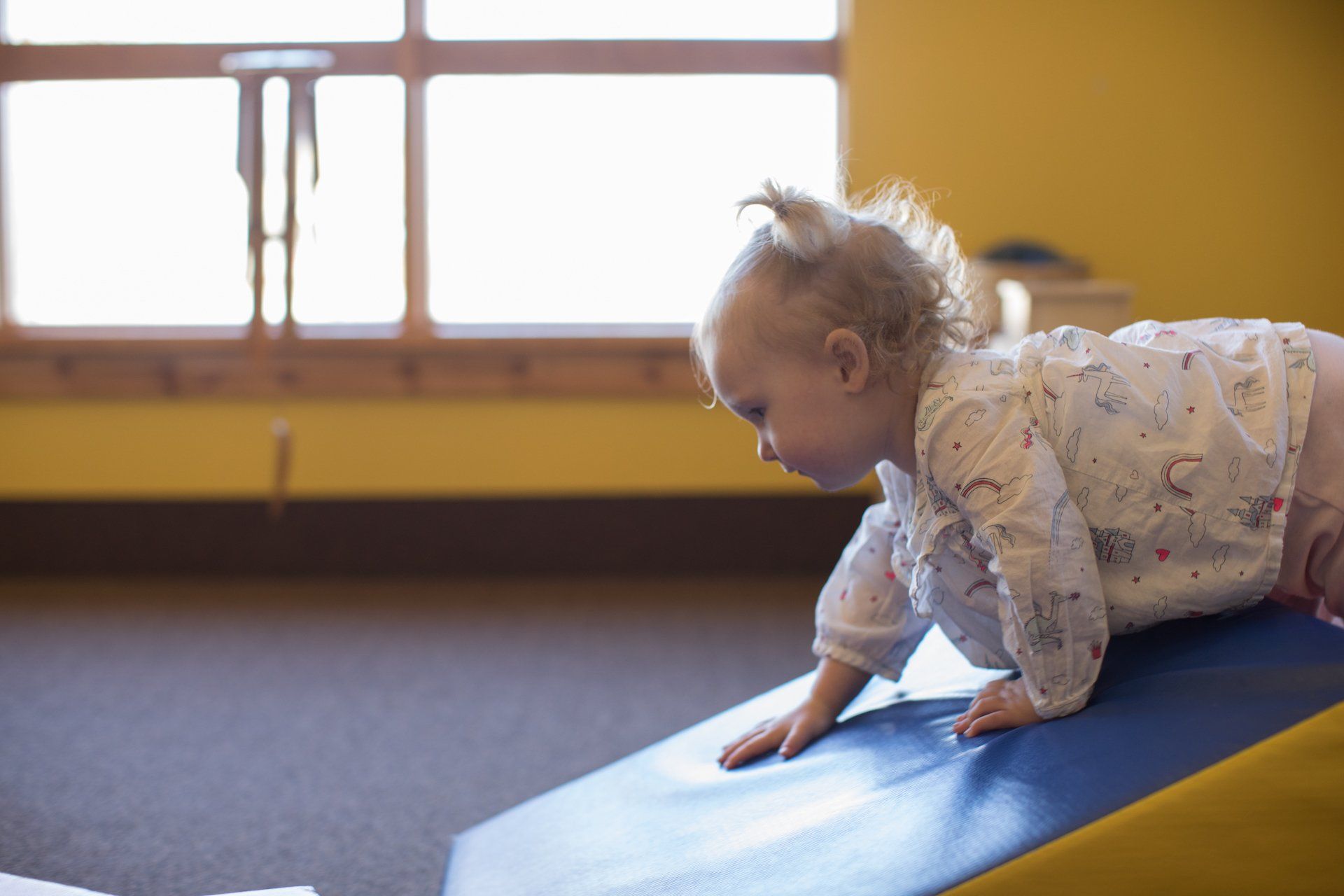
In Montessori, we honor children’s movement, even from birth! One reason why we focus so much on movement for young children is that healthy movement development in the first two years of life can provide our children with considerable benefits in the years to come.
So, let’s take a quick look at the science to better understand how to support our infants and toddlers during this critical time.
Movement & Myelination
At birth, movements are spontaneous and reflexive, like sucking and swallowing which are essential for survival. These early reflexive movements originate from the spinal cord and brain stem, but soon movement matures from the head down.
Our brains depend upon our sensory nervous system to share information about the surrounding world. This information actually shapes our brains’ connections and neural pathways.
For infants, these neural connections are just forming. As electrical signals move from one area of the brain to another, as well as down through the spinal cord to the rest of the body, they need smooth passage along what are called axons. Axons basically act like electrical wires conducting electrical signals.
Those signals need to be transmitted quickly and efficiently. Just like electrical wires need insulation so the electricity isn’t dissipated, axons need insulation, too! For more rapid passage of these electrical messages, axons become insulated by a layer of lipids and proteins, a process called myelination.
Babies are born without much myelin, which explains why their reaction times are so slow and movements so effortful. But with each experience and repetition, the myelin sheaths around axons get thicker. Myelin essentially greases the wires and allows signals to travel along the axons faster and more effectively.
More myelination in infants’ motor systems allows them to lift their heads, reach out, roll over, crawl, and eventually walk and run.
Mobiles for Movement
Within the first weeks of life after birth, babies begin to learn to control their eyes which means some of the first myelination happens with infants’ eye muscles.
To support this development, we provide carefully designed and placed mobiles, which help babies develop their visual capacities for focus and tracking. Changed as developmentally appropriate, mobiles offer newborns the opportunity to focus on an object, track it, perceive sensory details, and eventually attempt to reach for it.
When infants begin to reach for the mobile, we begin to offer something slightly different, like a bell hanging from a ribbon. Babies will try and try again, with great concentration and focus, to move their arms so as to make contact with the object and cause it to move or make a sound. They thus discover the relationship between sight and touch.
At first, physical contact with a hanging bell or ball may appear haphazard. Yet infants are seeing the item and making a muscular effort to connect with what they see. With repeated practice, infants are actually developing the myelin coating that will make their future efforts to reach and eventually grasp more efficient and successful.
Safe Space for Movement
For similar reasons, infants need space for movement. Often, we’re more apt to hold our infants or keep them in carriers. However, babies benefit from having space to move, and almost slither, their bodies on the floor. When you create the time and space for these slow whole-body movements, you’ll see that infants will often slither their bodies around in a clockwise direction!
When infants attempt to slither and move, they are very focused. This concentration allows them to start connecting how the mind and body work together. In Your Child’s Growing Mind: Brain Development and Learning from Birth to Adolescence, Dr. Jane Healy offers an important reminder: “After birth, physical activities are one of the child’s main means of advancing physical, intellectual, and emotional growth, so you should encourage many forms of body movement.”
Clothing also matters. In order to safely move their bodies, babies need clothing that doesn’t restrict their movements. Comfortable fabrics with forgiving elastics are best. Light clothing around the arms and legs offers more opportunities for movement and exploration. It’s also best to allow babies to have bare feet so they can have more sensory input and more traction as they begin to move.
Hands Send Information to the Brain
In addition to gross motor development, which will eventually progress from slithering to crawling to walking, infants are taking in information about the world through their hands.
In this process, babies develop an awareness of the connection between what they observe and what they touch. Sensory experiences begin to be linked to their mental development. Although little mitts are adorable and seem useful to keep infants from scratching themselves, it’s much more beneficial for babies’ development to have their hands uncovered.
Eventually, children begin to use their hands to not only take in information about the world but also to begin manipulating things in their surroundings. To help this development of hand movements, our little ones need purposeful activities that allow for exploration and the development of different types of hand grasps.
Children’s development of their hands is directly connected to the development of their brains. The brain sends a signal to the hand, and the hand moves and sends a sensory message back to the brain. With this new information, the brain can guide the hand in new ways, thus allowing the hand to discover more information by performing the new direction. And the feedback loop continues!
Gross Motor Skills Start with Tummy Time
While infants are developing these fine motor skills through coordination of their hands, they are also developing gross motor abilities. Early on babies need sufficient opportunities to develop large muscles, in particular their truck and neck. Thus, time lying on their belly is important, as this provides the opportunity for infants to push up with their arms and develop a stronger torso and neck.
Tummy time “push-ups” with the arms while in the stomach position are key in forming needed coordination and strength for all of their subsequent large-muscle development. Then, as infants develop enough torso and neck control to push themselves into a seated position, they free their hands for further exploration and development.
A similar process occurs when toddlers are able to move from cruising while holding on to objects for support, to walking without assistance. Suddenly they are able to move through their environment and use their hands for purposeful endeavors.
From “tummy-time” to rolling, to sitting up, to scooting, to crawling, and eventually, to cruising and walking, our young children are beginning to explore their world and develop their sense of self.
Developing Purposeful Movements
Dr. Maria Montessori explains that, as children gain strength through these activities, they begin to look toward those around them to imitate our actions and learn how to be a member of society. Children are interested in what we do and how we do it. They want to use their bodies in new and purposeful ways.
From the first days after birth, when a newborn can only control their eyes to see a mobile to when they move their hand and make contact with a bell hanging on a ribbon, these experiences help children recognize that they can control their movements. The sensory feedback helps strengthen an impulse within children to look or to try to move. Every experience involves movement. The more infants move, the more myelin they form, and the stronger their ability to act according to their own volition.
Movement Matters!
Sensorial experiences are vital for the development of movement and children use their movements to extend their understanding of the world. They see, hear, touch, and taste. The more they use parts of their body to explore their world, the more their movements become refined and the more they are able to make sense of their surroundings.
Children need the opportunity to explore, practice, and repeat movements through simulating and purposeful activity in a safe and supportive setting. Through these repeated experiences, our infants and toddlers develop their muscles, perfect their movements, and ultimately perfect themselves.
Although every child follows a typical timetable in terms of developing motor skills, their surroundings can either hinder or promote the acquisition and mastery of these abilities. Providing appropriate opportunities offers our children the chance for repeated practice and thus speeds the myelination process. Ultimately, as children develop their motor abilities, they come to recognize themselves as competent, capable, and unique individuals.
Want to see some competent, capable, and unique children moving through well-designed learning environments? Contact us today to schedule a visit!