
Stages of Development Series: Maturity

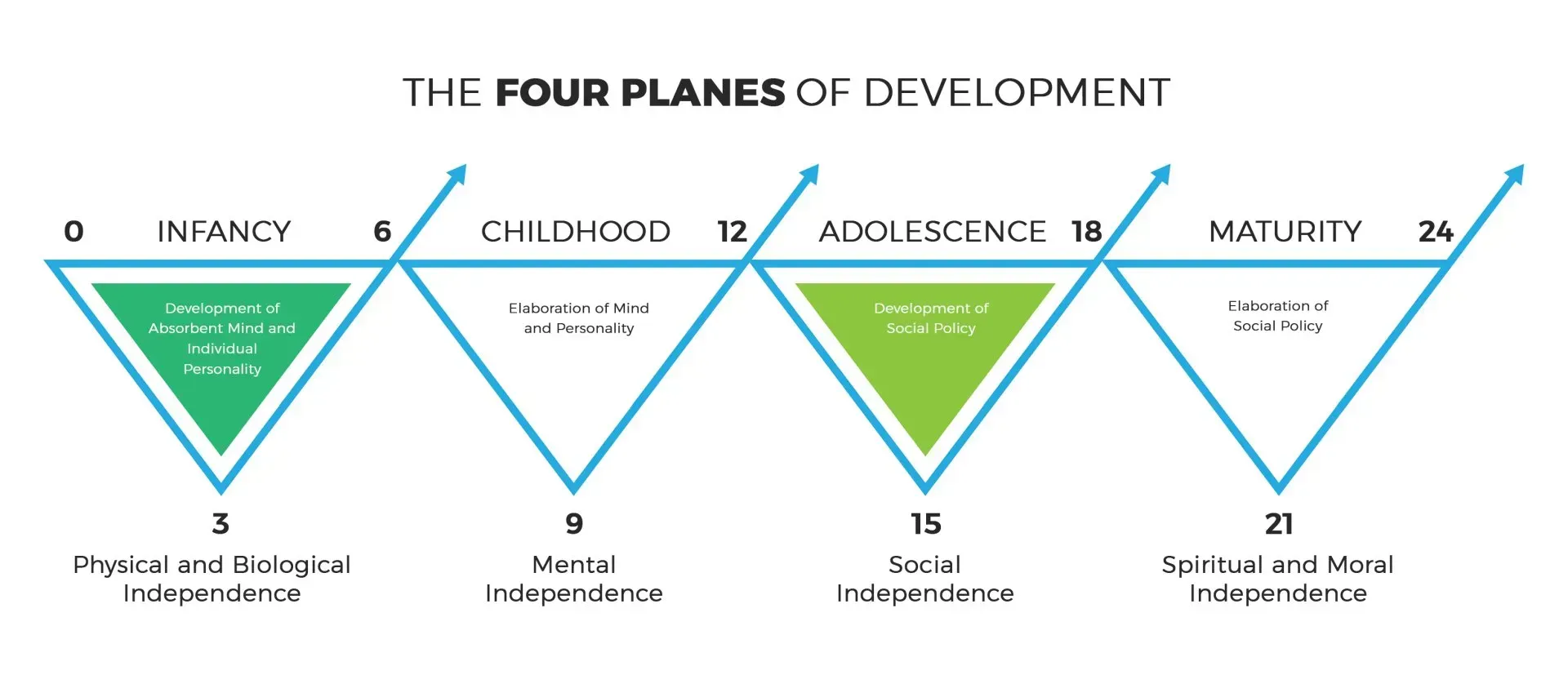
This is the final post of a series focusing on each of the four stages (or planes) of development: birth through age six, ages six to twelve, ages twelve to eighteen, and ages eighteen to twenty-four. Montessori pedagogy calls for a big picture perspective that incorporates the fundamental principles of human development at each stage of development and how we can best provide for a developing young person in each stage.
A Path Toward Maturity and Contribution to Society
The journey of human development, as envisioned by Dr. Maria Montessori, is marked by four distinct planes. Each plane represents a different phase in an individual's growth, and the fourth plane, spanning from 18 to 24 years of age, is no exception. This phase, which Montessori refers to as Maturity, signals the culmination of psychological and physical growth and paves the way for young adults to step into the world as a fully formed individuals capable of significant contributions to society.
Characteristics of the Fourth Plane
The fourth plane represents a time when individuals reach the height of their development and begin to assume their role in society. Unlike the earlier planes, the psychological changes during this period are less dramatic and more internal, and the focus shifts to understanding oneself and the world beyond one’s immediate needs. Whereas the body completes its physical maturation, the mind embarks on the task of understanding how it can contribute to humanity.
In The Four Planes of Education, Dr. Montessori writes, “The individual should be the man who knows how to make his own choice of action having passed to perfection the preceding phases. He should be as a live spark and aware of the open gate to the potentialities of prospective human life and of his own possibilities and responsibilities” (p. 15). This encapsulates the essence of the fourth plane— young adults’ newfound ability to make independent choices while being aware of their potential impact on society.
In this stage, individuals are not merely focused on themselves but are also learning to engage with the world beyond their personal ego. The question that arises is not “Who am I?” but “What can I do?” This shift from self-centeredness to a broader, more collective view of life signifies the maturity that defines the fourth plane.
Conquest of Independence
One of the key aspects of the fourth plane is the conquest of independence, particularly economic independence. This phase marks a time when individuals strive to become self-sufficient within the larger society. Young adults move beyond the dependency of childhood and adolescence, assuming more responsibility for their own life, finances, and future.
This is a period when a personal mission begins to take shape. Young adults start to solidify their goals, whether academic, professional, or personal, and work toward them with a growing sense of purpose. Dr. Montessori believed that achieving economic independence was crucial, as it not only provides the means to live but also fosters a sense of autonomy and responsibility.
Observable Examples of Development
Physically, by the fourth plane, development is largely complete. The dramatic growth spurts of the previous stages have slowed, and young adults now have full mastery over their body. Health is typically stable, and there is an overall sense of well-being.
Much like the second plane, the fourth plane is also conducive to intellectual pursuits, particularly those that lead to specialization in areas essential for a future career. This is when our young adults are honing skills that will serve them in the professional world, whether through higher education, apprenticeships, or other forms of specialized learning.
The fourth plane is also a time when individuals, having developed a solid understanding of themselves, are ready to take on more significant intellectual and social responsibilities. This is when they truly start asking the big questions, such as, “How can I contribute to the world?” It is at this stage that young adults embark on the exploration of their "cosmic task," a concept Montessori introduced in the second plane, which refers to the idea that every individual has a unique role to play in the larger story of humanity.
The Role of the Supportive Environment
With significant internal growth happening during the fourth plane, the role of the external environment remains crucial. A supportive environment during the preceding planes can have a profound effect on how individuals move through this stage. If our young adults have been nurtured in an environment that promotes autonomy, responsibility, and respect for their capacity to make choices, they are more likely to enter adulthood with the skills and mindset necessary to thrive in society.
To prepare for their careers during this time, many young adults pursue higher education, either through university studies or vocational training. Alternatively, they may enter the workforce, beginning to take on professional roles that contribute to society. This is also a time when many young adults leave the family home and start families of their own, further solidifying their place in the world as independent adults.
Dr. Montessori, unfortunately, did not have the opportunity to explore this phase in depth. However, we can imagine a world where every individual has been given the best possible environment throughout the previous planes of development. In such a world, adults who emerge from the fourth plane are equipped not only with the knowledge and skills to succeed but also with a profound sense of responsibility toward the greater good.
An Enlightened Society
The ideal outcome of the fourth plane is individuals who not only seek personal success but also work toward the welfare of humankind. Young adults who have passed through the earlier planes of development with the support of nurturing environments can enter society with a strong social conscience, eager to contribute to the collective well-being of humanity. They see the interconnectedness of all people and seek ways to address societal issues and contribute to the common good.
Imagine a world in which all young adults, having been guided through the previous developmental stages, emerge from the fourth plane ready to play their roles in society—not only as self-sufficient individuals but as enlightened members of a larger human community. This vision encapsulates the Montessori ideal: a world where everyone has the potential to contribute meaningfully to the advancement of humanity as a whole.
The fourth plane of development is not merely a time for self-discovery but a time for self-realization and societal contribution. Young adults, secure in their independence, prepare to engage with the world in ways that transcend personal goals, focusing instead on broader responsibilities. By fostering an environment that nurtures growth and independence, we set the stage for a society composed of individuals capable of making meaningful contributions to humanity’s collective well-being.
Curious to see how attention to the characteristics and needs of earlier stages of development can support an enlightened society? Schedule a tour today!